Traditions

Showing posts with label Hindu. Show all posts

Sunday, 21 December 2014

Mysteries Explored: Indian Customs Vs Scientific Reasons-2

7. Why do we worship Tulsi Plant:
Hindu Religion has betowed 'Tulsi' with the status of mother. Also known as 'Sacred of Holy Basil', Tulsi, has been recognized as a religious and spiritual devout in many parts of the world. The vedic sages knew the benefits of Tulsi and that is why they personified it as a Goddess and gave a clear message to the entire community that it needs to be taken care of by the people, literate or illiterate. We try to protect it because it is like Sanjeevani for the mankind. Tulsi has great medicinal properties, It is a remarkable antibiotic. Taking Tulsi everyday in tea or otherwise increases immunity and help the drinker prevent diseases, stabilize his or her health condition, balance his or her body system and most important of all, prolong his or her life. Keeping Tulsi plant at home prevents insects and mosquitoes from entering the house. It is said that snakes do not dare to go near a Tulsi plant. Maybe that is why ancient people would grow lots of Tulsi near their houses.

Monday, 15 December 2014

Mysteries Explored: Indian Customs Vs Scientific Reasons-1

Shocking science behind Hindu Traditions

Traditions in Hinduism were considered mainly as superstitions, but with the advent of science, it is becoming evident that these traditions are based on some scientific knowledge and moved from generations to generations as traditions, Though the common people did not know science in it, they were following it with faithfully over the years. This blog is an attempt to bring forward the science involved in these traditions and rituals...

1. Throwing Coins into the River:
The general reasoning given for this act is that it brings Good Luck.
However, scientifically speaking, in the ancient times, most of the currency used was made of copper unlike the stainless steel coins of today. Copper is a vital metal very useful to the human body,
Throwing coins in the river was on way our fore-fathers ensured we intake sufficient copper as part of the water as rivers were the only source of drinking water. Making it a custom ensure that all of follow the practice.

2. Joining Both Palms together to Greet:
In Hindu culture, people greet each other by joining their palms - termed as "Namaskar". The general reason behind this tradition is that greeting by joining both the palms means respect.
However, scientifically speaking, joining both hands ensures joining the tips of all the fingers together which are denoted to the pressure points of eyes, ears and mind. Pressing them together is said to activate the pressure points which helps us remember that person for a long time. And, no germs since we don't make any physical contact.

3. Why do Indian Women wear Toe Ring:
Wearing toe rings is not just the significance of married women but there is science behind it.
Normally toe rings are worn on the second toe. A particular nerve from the second toe connects the uterus and passes to heart, Wearing toe ring on this finger strengthens the uterus, It will keep it healthy by regulating the blood flow to it and menstrual cycle will be regularized. As Silver is a good conductor, it also absorbs polar energies from the earth and passes it to the body.

4. Applying Tilak on the Forehead:On the forehead, between the two eyebrows, is a spot that is considered as a major nerve point in human body since ancient times. The Tilak is believed to prevent the loss of "energy" the red "kumkum" between the eyebrows is said to retain energy in the human body and control various levels of concentration. While applying kumkum the points on the mid-brow region and Adnya-Chakra are automatically pressed. This also facilitates the blood supply to the face muscles.

5. Why do Temples have Bells:
People who are visiting the temple should and will Ring the bell before entering the inner sanctum (Garbhagudi or Garbha Gruha or womb-chamber) where the main idol is placed. According to Agama Sastra, the bell is used to give sound for keeping evil forced away and the ring of the bell is pleasant to God.
However, the scientific reason behind bells is that their ring clears our mind and helps us stay sharp and keep our full concentration on devotional purpose. These bells are made in such a way that when they produce a sound it creates a unity in the Left and Right parts of our brains. The moment we ring the bell, it produces a sharp and enduring sound which lasts for minimum of 7 seconds in echo mode. The duration of echo is good enough to activate all the seven healing centres in our body. This results in emptying our brain from all negative thoughts.

6. Why do we have Navratras:
Our living style has drastically changed if we compare it to the society hundreds and thousands of years ago. The traditions which we follow in present are not establishments of today but of the past. Ever thought, why do we have Navratras twice a year unlike other festivals like Deepawali or Holi? Well, both these months are the months of changing seasons and the eating habits of both the seasons are quite different from each other. Navratras give enough time to the body to adjust and prepare itself for to the changing season, These nine days were marked as a period when people would clean their body system by keeping fasts by avoiding excessive salt and sugar, meditate, gain a lot of positive energy, gain a lot of self confidence and increase the self determination power (fasts are a medium to improve our will power and self determination) and finally get ready for the challenges of the changed season.

Saturday, 7 June 2014

Cultural Symbols

Meditation

Meditating Yogi
The Indian Rishis attributed great importance to culture and stressed on the need for the development of the inner faculties of a human being. They discovered various methods of feeding, resting and revitalizing the body. After countless years of experience and experiments they developed special systems of exercises for increasing the strength, purity and power of all the faculties of man.

The Rishis claimed that God could be attained through meditation because then the mind eventually surrenders to a thought, which is subjected to long periods of concentration without any interruptions. In meditation, the performer attains a state of communion with his deity.

The rishis also preach that for sublimation and evolution, every person must meditate on God at least three times a day. They associate these times with the three times of the Sun. When one gets up from sleep, he must pay homage to his deity or the rising Sun to prepare for the day’s chores. He must respect the mid-day Sun when he prepares to eat meals for his sustenance and the setting Sun to express his gratitude to his Creator for the successful completion of his day’s work. They also proclaim that the most auspicious time for meditation is 3 am every day, because during this time, Mother Nature is the most serene. It is called Brahma Muhurta.

In order to attain spiritual progress, one must try to dissociate from worldly pleasures and attachments. Hence they advocated that meditation is supposed to be performed at a predetermined place, time and location for accelerated concentration. To make this easier they constructed temples, which are highly energized holy places.

In India, saints and sages have been meditating from time immemorial and they can be still found in many holy cities and riverbanks. Most of them give up their food and clothes to attain moksha or everlasting life. Saint Vivekananda is said to have meditated in the Rock Temple in Kanyakumari, the Southern tip of India for peace. Nowadays even common Indians have started to make a beeline to Ashrams which propose to teach them meditation and concentration to attain peace in life.

Yogis or Rishis

Yogis or Rishis
In the Bhagavad Gita, Shree Krishna teaches Arjun that   a “YOGI” is one who is joined to God. The path that leads to ideals is that of a yogi who consciously and deliberately progresses towards divinity, which is the purpose of creation. With yogic advance his mind gets purified and he later becomes a Siddha Saint.

An ascetic is one who undergoes voluntary sacrifices to obtain celestial powers, like going without food or clothes for days, standing on ones head for hours together, sleeping on a bed of nails, piercing ones body with sharp objects, etc.

All those who practice meditation, concentration and purification of their mind and body senses are real Yogis. There can be no higher state than this because they are nearer to God by way of worshipping him.   In worldly terms they have long hairs, and a flourishing beard and wear saffron or white or black robes.

The Sacrificial Fire

The Sacrificial Fire
Almost most of the Indian religions worship fire as a benevolent element. From time immemorial the sacrificial fire has been an important item of our culture. Every function, ceremony, worship or Puja starts with the worship of the fire in some form or the other. Most of the Indian women perform a small worship of the deity in their house with a special “ARTI” of a small deepam or lamp and incense sticks. The importance of fire worship is mentioned in all the Vedas and religious books.

Some modern thoughts regard the Fire Worship as a primitive practice of campfire. But scientists have established that performing a small domestic “havan” or fire worship with ghee and other specified ingredients produces purifying gases like ethylene oxide, propylene oxide, formaldehyde, butapropiolactone and acetylene which boost up the spirit of the performer and the surroundings.

Rishis perform Havan in the ashrams to purify it and give it an atmosphere of good health and prosperity. Fire worship is done in India, for prosperity, health, victory, thanksgiving, good crop, bountiful rain, etc. Twigs and dried leaves of some special trees, rice, wheat, til seeds, guggal, camphor, raisins, coconut, vermilion and turmeric are used for the fire worship. Guggal and Camphor are supposed to be good germ-killers. The burning of these items in the fire along with the addition of pure ghee and the reciting of Mantras produces beneficial gases according to the Rishis. They prescribe the morning or evening as the ideal time for performing this worship. But the Tantriks prefer to perform their Yagna at midnight, nearest to a cremation ground!

Deepam or Lamp

Deepam or Lamp
The Rishis of India worship FLAME or JYOTI or DEEPAM, as being the purest of the pure because it consumes all impurities but yet remains pure by itself.

A lamp is an earthen saucer like container, filled with ghee or butter with a twisted cotton tape immersed in it. It is lighted in every Hindu household and temple in India. The cotton tape keeps sucking the ghee to yield a cool bright light, a flame.  In nature the flame is considered to be the source of infinite energy of positive currents. If even number of lamps is kept side by side, they cancel each other’s radiation and become harmful. This explains the use of odd number of lamps for worship.

Great emphasis is also placed on performing “ARTI” in India during worship of any deity. The arti flame is moved around the idol for the devotees to have a good look of the deity, then the devotees put out their palms to receive the arti aura, when their body’s energy rises to the level of the flame according to researchers. The flame is also considered a good germ killer.

Tree worship

Trees are considered to be friends of man as they provide him shelter, food, fuel, and oxygen for good living. In the Rigveda and the Atharveda some trees are deified, as “Vriksha Devta” which are considered to be holy and the people ought to worship them. The Pipal, Banyan, Goolar, Amla, Vilva, Sandal, Neem, Mango, and Babool are the trees that are worshipped in India.

It is said that Gods and the souls of pious ancestors rest on the branches of the Pipal tree and so it is not a domestic tree, instead it is grown in temples and inns where people come to worship. The Pineal gland’s secretions of humans make their brains alert and alive. The chemical found in this secretion is also found in the Pipals’ juice according to scientists and hence it is called the Bodhi Vriksha.

The Banyan tree is of specialty because it sends sap from above to the earth. This resembles the functioning of the world, as it also needs sap or energy for its survival from above, God. Married Hindu ladies worship the Banyan tree for a long and happy married life.
Lord Shiva patronizes the Vilva tree as the only tree, which has three, leaves that sprout together like a trident. The juice of the leaves is a relief to the Diabetics, and the pulp of the fruit is supposed to stop diarrhea. The fruit called bel was a favorite of Lord Shiva.
Another tree is the Asoka tree which is known to relieve the worries of the persons sitting under its shade. Sita is said to have been seated under an Asoka tree in Lanka during her captivity.

The Hindus also worship the Kadam tree, because Shree Krishna used to sit and play under this tree.
Rishi Chyavan patronized the Amla tree for rejuvenating properties.

Tulsi worship


According to popular Indian belief, Wherever Tulsi is planted, the place becomes, sanctified as a place of pilgrimage and the sepoys of Lord Death dare not enter that place. In India, the Tulsi is regarded as the most sacred plant. It is a much- branched erect bushy plant of about 4 feet height. Its leaves are aromatic and they have minute glands. The flowers are purple in small clusters and the seeds are yellow are red.

According to scientists the place containing tulsi plant becomes pollution free. The oil of the leaves is capable of destroying bacteria and insects. The leaves have mercury traces and are hence nowadays used in cancer curing Ayurvedic medicines. The juice of the leaves cures bronchitis and stomach upsets. The leaves’ paste cure all skin diseases and the decoction of the leaves cures common cold.

Thick branches of Tulsi are dried and cut into beads to make rosary beads, are else they are made into necklaces which the devotees wear with faith. The ancient Rishis have ordained that if a ghee lamp or incense stick or flowers are not available for performing puja then Tulsi leaves can be used and this explains the importance of the worship of tulsi in India.

Betel Leaf (Paan)

Betel Leaf (Paan)
During worship or rituals, leaves from some select trees are used as essential accessories, but among them all the Betel Leaf enjoys a place of pride in India. In Hindu weddings, a betel leaf is tucked into the headgear of the bride and the groom. The use of betel leaf is considered as a noble trait and on all auspicious celebrations, betel leaf has become a symbolic item denoting freshness and prosperity.

The Skanda Purana says that the Betel Leaf was obtained during the ocean- churning by the Gods. The use of Betel Leaf in India is mentioned in the great epics, The Ramayana and the Mahabharatha as well as in Buddhist and Jain literatures.

Paan has rich herbal properties. It is invigorating and energizing, a killer of germs and bacteria and an eliminator of cold. Before eating a paan, the stalk has to be cut, the edges have to be trimmed and the veins have to be scrapped because they may damage the brain. There are whitish and blackish betel leaves. The black variety is said to be constipative and the white one eliminates cold and is a digestive.

Coconut (Nariyel) in rituals

Coconut (Nariyel) in rituals
n India, for success and prosperity on all occasions, the beginning is done with the breaking of a sanctified coconut. All religious functions and rituals start with the worship of the coconut since it is regarded as the symbolic GANESH, the deity who helps in the successful completion of any work undertaken.

Sage Vishwamitra is said to be the creator of coconut. Its hard kernel inspires one to do hard work for attaining success. People get strength and improved eyesight by eating the kernel. The sick and the elderly find its water nourishing and ladies apply its oil for luxurious hair. It has glucose, phosphorous and carbohydrates in good measures and so it is good for Diabetics. Germs can’t penetrate its hard kernel so it remains intact for months together.

Ancient Indian doctors used to burn its outer shell to prepare tooth powder, eyebrow creams and ointments for burns. Every inch of the coconut plant is very beneficial to humans. Hence Indians consider it a good omen to receive or give coconut fruits as gifts. It is also called Shreephal because it denotes prosperity.

Lotus Flower

Lotus Flower
Lotus is a very important symbol of Indian cultural heritage. It is mentioned in all the Hindu scriptures because it is very sacred to the Gods. God Brahma and Buddha are depicted as seated on a Lotus flower. Lord Vishnu holds a lotus in one of his hands and Goddess Lakshmi also holds a Lotus flower. The Lotus is an appropriate symbol of detachment from the surroundings, be it good or bad.

The Indian Poets have used the Lotus as a simile in praise of the feet of the Gods and Goddesses. All the Vedas sing in praise of the Lotus. In the Yogasastra, the six Chakras are depicted with the Lotus as the base. According to the Mahayana sect of Buddhism, all the souls originate from the Lotus.

In India, the Muslim rulers used the Lotus in their architecture, an influence of Hindu architecture since the Muslims have no special significance for the Lotus. The dome of the Taj Mahal resembles an upside-closed lotus, resting on its petals. The lotus blooms with the morning light and closes its petals when the sun goes down. So the sages accepted lotus as a unique symbol of unfolding the spiritual qualities of man with the advent of light.

AUM


According to the Hindu Yogis in India, inhaling air generates SH-Sh sound while exhaling is associated with HM-HM and enunciated that SOHAM is the keynote of life. Later they discovered that sound O was guttural and sound AM touched palate and so told that AUM encompassed man’s total existence.
The Aum sound is vibrating throughout the cosmos and it has three manifestations; those of creations, preservations and destruction. Every time a person utters any letter or word, he puts into operation any of these three virtues of AUM. The vibratory cosmic energy- AUM does not maintain by food alone, but man’s body battery. This invisible power flows through the human body and controls its actions when uttered properly with reverence and concentration.

Tilak or Dot or Bindi

NaamamCircular Bindi worn by indian women
The starting point of all shapes and forms is a point. Geometry describes the point as one, which has no dimensions, but it still exists.  A dot or point is the seed of language expressed by sound, so it is the finale of the highest attainment.

A dot or point is the abode of Shiva and Shakthi.  Ancient Indian had an indomitable urge to communicate his thoughts and so symbols were developed. Similar group of men and women adopted different types of Tilak or linear symbols, which were further, segregated fro man and woman to wear on their body to denote their sect and ideology.

A deep study of human anatomy reveals that the forehead is the best place for applying Tilak. Rishis declared that the junction of the nose-root and the meeting point of the eyebrows is the most sensitive part of the body. The Agya- chakra, or Wheel of wisdom, is located here and so is a vulnerable spot, which must be kept, warm and protected.

The most popular forms used or a dot, or a “U” shape or a trident shape or 3 horizontal lines with a dot at the center called Tripund on the forehead and forearms. The wearers are advised by the rishis to use a mixture of vermillion, lime, turmeric, saffron, musk, agar, sandal and ash for men and sindur or vermillion on their skull-center for the women, to provide warmth to the pineal and pituitary glands located near the Thalamus.

The bindi is declared to be very helpful for the good health of the brain, eyes, ears and the nose because these applications maintain a fine pull on the veins and nerves underneath the forehead, nose-root and forearm’s skin to monitor proper flow of blood. The forebrain controls the decision making part of the brain. In acupressure methods it is considered to be the most sensitive part of the body responsible for alertness and hence the use of Bindi for the forehead is justified.

Swastik


Mostly the business community considers the Swastik symbol as the symbol of all- round prosperity in India. The root of SWASTIK is SU+US; SU means benefic and US means existence; so whosoever desires to have glory, prosperity, progress and success is advised to invoke the Swastika Yantra.

The Aryans adopted the Swastik as a symbol for the good of humanity. Then the Hindus added some more arms to the Swastik to denote happiness in married life and worldly successes.

The sides of the Swastik arms must remain on the right side, moving or stationary for positive vibrations and benevolent results. BOVIS is a measure of the energy levels that surround men or materials and the Swastik is supposed to have a formidable energy of one million bovis, but in an inverse direction, the results become negative.

Indian Siddhants say that the center of the Swastik represents the uterus, the origin point of the Universe, the vertical line, Shiva and the horizontal line, the female organ. Their cross forms the origin and evolution of the whole world.

Certain shapes represent deities and when a devotee invokes the deity through the symbol, his thoughts are concentrated and good results are got and one such omnipotent symbol is the Swastik, which is widely used in India.

Rudraksha Mala

Rudraksha Mala
It is a common sight in India, to see saints and rishis wearing small ball-like seeds in a string around their neck. They are called Rudraksha Mala and a visit to any holy place in India, can take you to shops that sell these bead-necklaces in all colors and prices.

Rudraksha is the seed of a fruit of a rare species of a tree found in Karnataka and in the Konkan area. It is roundish with a cellular demarcation and has a central bore. Each seed may have 1 to 21 cells and the seeds with one cell are of great sanctity value. The most common variety is the seeds with 5 cellular divisions.

It has a beneficial property of attracting healthy vibrations and so saints and rishis wear them as necklaces. The Lord Shiva is also found to wear one such thing in his neck. A real rudraksha seed shall sink in water and so fake ones can be differentiated easily.

Its aromatic property helps a devotee to get into deep meditation easily. Rudraksha seeds are not supposed to be rubbed often   because then they lose their charm properties. It should be worn on the neck, threaded by gold, silver or woolen threads, so that it remains in gentle touch with the body, which increases the body’s immunity.

The rudraksha thread protects the wearer from lightings, accidents and brings him good luck according to Indian saints and rishis. People with positive currents of energy should wear it on their right hand and those with negative energy current on their left hands, for good results.

Sacred Thread

The Brahmanas and some sects of artisans wear the Sacred Thread as a symbol of their holiness when compared to the common man. They are considered to be next to God. In India, a tuft of hair in the back of the head, a rosary in the hand, a prominent bindi on the forehead and a sacred thread along the torso are considered to be some of the important symbols of holiness among the Hindus.

The sacred thread consists of hand -spun yarn. Three equal lengths of the yarn are twisted to form one length. After a sacred thread ceremony the person is given a sacredness status. He is supposed to wear it as a cross-belt on his body.

The three twisted yarns represent the Trinity of God, or the three virtues of life namely; pious living, imperious living and vicious living. The 3*3 also represents the Navagraha or the nine planets and also the nine outlets of the human body. The threads are bright white and so they also add to the aura and moral strength.

In India, the Zoroastrians wear such a sacred thread around their lumbar region. According to their belief, the belt keeps their lumbar region vertebras   in position and gives proper alignment.

Kalash (Sacred Pot)
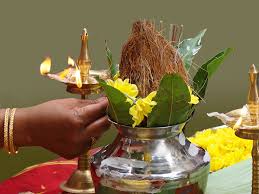

In ancient times, the rishis of India placed copper pots atop temple pinnacles to escape the calamity of lightning. But fungus developed on the pots and reduced their efficiency and so they gold-enameled the pots with gold.

The Rishis wanted water all year round to quench their thirst, so they developed a container- a Kalash and they were happy that they could enshrine God Varun in the Kalash and thus the worship of Varun started with the worshipping of the Kalash. The Rishis also ordained that every ceremony should start with the worship of the Kalash.

According to Indian mythology, The mouth of the Kalash represents Vishnu, the throat - Lord shiva, Lord Brahma adores the base and at the belly all Goddesses are established and thus in a small pot they established the presence of all gods and goddesses.

In India, on most of the ceremonial occasions, a pot filled with clean water, with fresh mango or betel leaves placed at the mouth and a coconut placed on top is kept near the entrance. It is also decorated with Swastik symbol and other ornamentations.

Ringing of bells
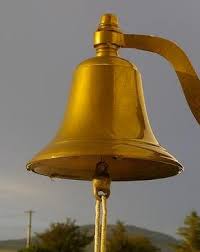

Centuries ago in India, the Gurukul system of education- residential Institutions for overall development of students, were situated in forests away from the crowded townships. There the insiders were constantly under beastly attacks and so bells were rung on the sighting of deadly animals to frighten them off. The metallic sounds were also found to attack bacteria and germs through scientific research.

To create very effective sound, a bell was found to be the best device since when it is made of 8 different metals, it produced the most resounding echo, which can spread in all directions. In India, regular rhythmic ringing of heavy and light weight bells has been made compulsory during the time of worship in most of the temples, so as to invoke the deity’s blessings.

Research has proved that that the sound of a standard bell can cure physical as well as mental diseases. Loud sounds of the bell or the blowing of the conch, gets 27 cubic feet of air in an area of 1220 sq.ft, purified and it is taken to be the most economical way of purifying the environment.

 For worship, blowing of conch, a type of shell, bells of different dimensions, the beating of metallic-alloy plates, Jhang, Majira, etc are very common in India.

Conch shells (Shankh)


The Conch Shell or Shankh was obtained as a gift from the ocean - churning by the Gods. The spiral formation inside the conch -shell is symbolic of infinite space. All naturally occurring conch shells yield cosmic sounds, which can be heard by holding the shell close to one’s ears.

God Vishnu accepted an attractive conch shell with its mouth on the right side, and another with a left-side opening adores the hand of Goddess Lakshmi.

The blowing of the conch shell heralds important events and auspicious celebrations and calls all the faithful for the worship of the deity. On the battlefield of Kurushetra in the Mahabharatha, every morning the blowing of the shankh, symbolized the starting of the war.  Every great King and Army- Chief had his own precious Shankh or conch shell.

Vastu shastra - Indian astrology

In India, Vaastu Shastra, the details about the different dimensions of buildings, temples, forts, townships, houses, etc is a great emerging science in the field of architecture. Architecture is not just raising buildings to limit space according to Indian Rishis. It is a form of science where, constructions are made in harmony with the laws of Creation. A particular proportion of materials, a combination of colors, a particular timing to start the construction is some of the things to consider giving good benefits for the occupier of the construction to be erected.

The principles of VastuShastra are based on physical geography, rainfall, isobars, winds, ocean currents, natural vegetation, climate, water resources, mineral resources, population, etc. Vastu Shastra is basically the utilization of living space so that it harmonizes the person with the elements by working in harmony with the earth’s magnetic currents.

In India, as per Vaastu Shastra, North and the East are the most auspicious. Plot of square, rectangle or trapezium can be selected but not a triangular one as this may block the energy waves. Northeast is the air zone, so the drawing room can be located in this direction. The main entrance or water resources of a house can also be located in the North- East Zone. The South- East side is dedicated to fire, so kitchen can be in the Southeast or Northwest but not in the Southwest as this may bring sickness to the members.
According to Indian Rishis, the following of the Vaastu Shastra principles brings good-fortune or at the least averts any bad-luck for the occupants.

Kumbh Mela


The Kumbh Mela in India is as mesmerizing as it is spiritual. This ancient northern Indian festival is a meeting of mystical minds. The largest religious gathering in the world, the Kumbh Mela brings Hindu holy men together to discuss their faith and disseminate information about their religion. It's attended by millions of people each day.

Where is the Kumbh Mela Held

The Mela takes place on a rotational basis in four of the most holy Hindu places in India -- on the banks of the Godavari river in Nashik (Maharastra), the Shipra river in Ujjain (Madhya Pradesh), the Ganges river in Haridwar (Uttarakhand), and convergence of the Ganges, Yamuna, and Saraswati rivers in Allahabad/Prayag (Uttar Pradesh).

When is the Kumbh Mela Held

In each location once every 12 years. Theoretically, it should happen every three years in a different place. However, the exact time and place of the festival depends on astrological and religious considerations. This means that the Mela sometimes happens only a year apart at the different sites.

There is also a Maha Kumbh Mela, which is held once every 12 years. In between, in the sixth year, the Ardh Kumbh Mela (half mela) takes place as well.

The Maha Kumbh Mela is considered to be the most auspicious mela. It always occurs in Allahabad, as the confluence of the rivers there is considered to be particularly holy. The Ardh Kumb Mela occurs in both Allahabad and Haridwar.

What is the Legend Behind the Kumbh Mela

Kumbh means pot or pitcher. Mela means festival or fair. Hence, the Kumbh Mela means festival of the pot. It specifically relates to the pot of nectar in Hindu mythology.

Legend has it that the gods once lost their strength. In order to regain it, they agreed with the demons to churn the primordial ocean of milk for amrit (the nectar of immortality). This was to be shared equally between them. However, a fight broke out, which went on for 12 human years. During the battle, the celestial bird, Garuda, flew away with the Kumbh that held the nectar. Drops of nectar are believed to have fallen in the places that the Kumbh Mela is now held -- Prayag (Allahabad), Haridwar, Nashik, and Ujjain.

The Sadhus at the Kumbh Mela

The sadhus and other holy men are an integral part of the Mela. Pilgrims who attend it come to see and listen to these men, in order to gain spiritual enlightenment.

There are various types of sadhus:

Nagas -- naked sadhus who smear their bodies with ash and have long matted hair. Constant exposure to the weather makes them resistant to temperature extremes. Their eyes are bloodshot from constantly smoking charas (marijuana), which they believe aids enlightenment.
Urdhwavahurs -- who have emaciated bodies from rigid spiritual practices.
Parivajakas -- who have taken a vow of silence.
Shirshasinse -- who remain standing, sleep with their heads resting on a vertical pole, and meditate standing on their heads.
Kalpvasis -- who remain by the river banks and devote their time to meditating, performing rituals, and bathing numerous times a day.
What Rituals are Performed at the Kumbh Mela

The main ritual is the ritual bath. Hindus believe that submerging themselves in the sacred waters on the most auspicious day of the new moon will absolve them and their ancestors of sin, thus ending the cycle of rebirth. Pilgrims start lining up to bathe from around 3 a.m. on this day.

As the sun comes up, the different groups of sadhus move in procession towards the river to bathe. The Nagas usually lead, while each group tries to outdo the others with more grandeur and fanfare. The moment is magical, and everyone is absorbed in it.

After bathing, the pilgrims wear fresh clothes and proceed to worship by the river bank. They then walk around listening to discourses from the various sadhus.

Sunday, 25 May 2014

Carnatic music

Carnatic music or Karnāṭaka Saṃgīta is a system of music commonly associated with the southern part of the Indian subcontinent, with its area roughly confined to four modern states of India: Andhra Pradesh, Karnataka, Kerala, and Tamil Nadu. It is one of two main sub-genres of Indian classical music that evolved from ancient Hindu traditions; the other sub-genre being Hindustani music, which emerged as a distinct form because of Persian and Islamic influences in North India. The main emphasis in Carnatic music is on vocal music; most compositions are written to be sung, and even when played on instruments, they are meant to be performed ingāyaki (singing) style.
Although there are stylistic differences, the basic elements of śruti (the relative musical pitch), swara (the musical sound of a single note), rāga (the mode or melodic formulæ), and tala (the rhythmic cycles) form the foundation of improvisation and composition in both Carnatic and Hindustani music. Although improvisation plays an important role, Carnatic music is mainly sung through compositions, especially the kriti (or kirtanam) – a form developed between the 14th and 20th centuries by composers such as Purandara Dasa and the Trinity of Carnatic music. Carnatic music is also usually taught and learnt through compositions.
Carnatic music is usually performed by a small ensemble of musicians, consisting of a principal performer (usually a vocalist), a melodic accompaniment (usually a violin), a rhythm accompaniment (usually a mridangam), and a tambura, which acts as a drone throughout the performance. Other typical instruments used in performances may include the ghatam, kanjira, morsing, venu flute,veena, and chitraveena. The most outstanding performances, and the greatest concentration of Carnatic musicians, are found in the city of Chennai.[1] Various festivals are held throughout India and abroad which mainly consist of Carnatic music performances, like the Madras Music Season, which has been considered as one of the world's largest cultural events.
Origins, sources and history

Like all art forms in Indian culture, Indian classical music is believed to be a divine art form which originated from the Devas and Devis(Hindu Gods and Goddesses), and is venerated as symbolic of nāda brāhman. Ancient treatises also describe the connection of the origin of the swaras, or notes, to the sounds of animals and birds and man's effort to simulate these sounds through a keen sense of observation and perception. The Sama Veda, which is believed to have laid the foundation for Indian classical music, consists of hymns from the Rigveda, set to musical tunes which would be sung using three to seven musical notes during Vedicyajnas. The Yajur-Veda, which mainly consists of sacrificial formulae, mentions the veena as an accompaniment to vocal recitations. References to Indian classical music are made in many ancient texts, including epics like the Ramayana andMahabharata. The Yajnavalkya Smriti mentions vīṇāvādana tattvajñaḥ śrutijātiviśāradaḥ tālajñaścāprayāsena mokṣamārgaṃ niyacchati ("The one who is well versed in veena, one who has the knowledge of srutis and one who is adept in tala, attains salvation without doubt"). Carnatic music is based as it is today on musical concepts (including swara, raga, and tala) that were described in detail in several ancient works, particularly the Bharata's Natya Shastra and Silappadhikaram by Ilango Adigal.
Owing to Persian and Islamic influences in North India from the 12th century onwards, Indian classical music began to diverge into two distinct styles, being Hindustani music and Carnatic music. Commentaries and other works, such as Sharngadeva's Sangita Ratnakara, further elaborated on the musical concepts found in Indian classical music. By the 16th and 17th centuries, there was a clear demarcation between Carnatic and Hindustani music; Carnatic music remained relatively unaffected by Persian and Arabic influences. It was at this time that Carnatic music flourished in Vijayanagara, while the Vijayanagar Empire reached its greatest extent. Purandara Dasa, who is known as the father (Pitamaha) of Carnatic Music, formulated the system that is commonly used for the teaching of Carnatic music. Venkatamakhin invented and authored the formula for the melakarta system of raga classification in his Sanskrit work, the Chaturdandi Prakasika (1660 AD). Govindacharya is known for expanding the melakarta system into the sampoorna raga scheme – the system that is in common use today.
Carnatic music was mainly patronized by the local kings of the Kingdom of Mysore and Kingdom of Travancore in the 18th through 20th centuries. Some of the royalty of the kingdoms of Mysore and Travancore were themselves noted composers and proficient in playing musical instruments, such as the veena, rudra veena, violin, ghatam, flute, mridangam, nagaswara and swarabhat. Some famous court-musiciansproficient in music were Veene Sheshanna (1852–1926) and Veene Subbanna (1861–1939), among others.
With the dissolution of the erstwhile princely states and the Indian independence movement reaching its conclusion in 1947, Carnatic music went through a radical shift in patronage into an art of the masses with ticketed performances organized by private institutions called sabhās. During the 19th century, the city of Chennai (then known as Madras) emerged as the locus for Carnatic music.
Nature of Carnatic music
The main emphasis in Carnatic music is on vocal music; most compositions are written to be sung, and even when played on instruments, they are meant to be performed in a singing style (known as gāyaki). Like Hindustani music, Carnatic music rests on two main elements: rāga, the modes or melodic formulæ, and tāḷa, the rhythmic cycles.
Today, Carnatic music is presented by musicians in concerts or recordings, either vocally or through instruments. Carnatic music itself developed around musical works or compositions of phenomenal composers (see below).
Important elements of Carnatic music
Śruti
Main article: Śruti (music)
Śruti commonly refers to musical pitch. It is the approximate equivalent of a tonic (or less precisely a key) in Western music; it is the note from which all the others are derived. It is also used in the sense of graded pitches in an octave. While there are an infinite number of sounds falling within a scale (or raga) in Carnatic music, the number that can be distinguished by auditory perception is twenty-two (although over the years, several of them have converged). In this sense, while sruti is determined by auditory perception, it is also an expression in the listener's mind.
Swara
Main article: Swara
Swara refers to a type of musical sound that is a single note, which defines a relative (higher or lower) position of a note, rather than a defined frequency. Swaras also refer to the solfege of Carnatic music, which consist of seven notes, "sa-ri-ga-ma-pa-da-ni" (compare with the Hindustani sargam: sa-re-ga-ma-pa-dha-ni or Western do-re-mi-fa-so-la-ti). These names are abbreviations of the longer names shadja, rishabha, gandhara, madhyama, panchama, dhaivata and nishada. Unlike other music systems, every member of the solfege (called a swara) has three variants. The exceptions are the drone notes, shadja and panchama (also known as the tonic and the dominant), which have only one form; andmadhyama (the subdominant), which has two forms. A 7th century stone inscription in Kudumiyan Malai in Tamil Nadu shows vowel changes to solfege symbols with ra, ri, ru etc. to denote the higher quarter-tones. In one scale, or raga, there is usually only one variant of each note present. The exceptions exist in "light" ragas, in which, for artistic effect, there may be two, one ascending (in the arohanam) and another descending (in the avarohanam).
Raga system
A raga in Carnatic music prescribes a set of rules for building a melody – very similar to the Western concept of mode. It specifies rules for movements up (aarohanam) and down (avarohanam), the scale of which notes should figure more and which notes should be used more sparingly, which notes may be sung with gamaka (ornamentation), which phrases should be used or avoided, and so on. In effect, it is a series of obligatory musical events which must be observed, either absolutely or with a particular frequency.
In Carnatic music, the sampoorna ragas (those with all seven notes in their scales) are classified into a system called the melakarta, which groups them according to the kinds of notes that they have. There are seventy-two melakarta ragas, thirty six of whose madhyama (subdominant) is sadharana (perfect fourth from the tonic), the remaining thirty-six of whose madhyama (subdominant) is prati (an augmented fourth from the tonic). The ragas are grouped into sets of six, called chakras ("wheels", though actually segments in the conventional representation) grouped according to the supertonic and mediant scale degrees. There is a system known as the katapayadi sankhya to determine the names ofmelakarta ragas.
Ragas may be divided into two classes: janaka ragas (i.e. melakarta or parent ragas) and janya ragas (descendant ragas of a particular janaka raga). Janya ragas are themselves subclassified into various categories.
Tala system
Main article: Tala (music)
Tala refers to a fixed time cycle or metre, set for a particular composition, which is built from groupings of beats. Talas have cycles of a defined number of beats and rarely change within a song. They have specific components, which in combinations can give rise to the variety to exist (over 108), allowing different compositions to have different rhythms.
Carnatic music singers usually keep the beat by moving their hands up and down in specified patterns, and using their fingers simultaneously to keep time. Tala is formed with three basic parts (called angas) which are laghu, dhrtam, and anudhrtam, though complex talas may have other parts like plutam, guru, and kaakapaadam. There are seven basictala groups which can be formed from the laghu, dhrtam, and anudhrtam:
·         Dhruva tala
·         Matya tala[citation needed]
·         Rupaka tala
·         Jhampa tala
·         Triputa tala
·         Ata tala
·         Eka tala
A laghu has five variants (called jaathis) based on the counting pattern. Five jaathis times seven tala groups gives thirty-five basic talas, although use of other angas results in a total of 108 talas.
Improvisation
Improvisation in raga is the soul of Indian classical music  – an essential aspect. "Manodharma Sangeetam" or "kalpana Sangeetam" ("music of imagination") as it is known in Carnatic music, embraces several varieties of improvisation.
The main traditional forms of improvisation in Carnatic music consist of the following
·         Alapana
·         Niraval
·         Swarakalpana
·         Ragam
·         Tanam
·         Pallavi
·         Tani Avartanam

Raga Alapana
An alapana, sometimes also called ragam, is the exposition of a raga or tone – a slow improvisation with no rhythm, where the raga acts as the basis of embellishment. In performing alapana, performers consider each raga as an object that has beginnings and endings and consists somehow of sequences of thought.
The performer will explore the ragam and touch on its various nuances, singing in the lower octaves first, then gradually moving up to higher octaves, while giving a hint of the song to be performed.
Theoretically, this ought to be the easiest type of improvisation, since the rules are so few, but in fact, it takes much skill to sing a pleasing, comprehensive (in the sense of giving a "feel for the ragam") and, most importantly, original raga alapana.

Niraval
Niraval, usually performed by the more advanced performers, consists of singing one or two lines of text of a song repeatedly, but with a series of melodic improvised elaborations. Although niraval consists of extempore melodic variations, generally, the original patterns of duration are maintained; each word in the lines of text stay set within their original place (idam) in the tala cycle. The lines are then also played at different levels of speed which can include double speed, triple speed, quadruple speed and even sextuple speed. The improvised elaborations are made with a view of outlining the raga, the tempo, and the theme of the composition.[citation needed]

Kalpanaswaram
Kalpanaswaram, also known as swarakalpana, consists of improvising melodic and rhythmic passages using swaras (solfa syllables). Like niraval, kalpanaswaras are sung to end on a particular swara in the raga of the melody and at a specific place (idam) in the tala cycle.
Kalpanaswaras have a somewhat predictable rhythmical structure; the swaras are sung to end on the samam (the first beat of the rhythmical cycle). The swaras can also be sung at the same speed or double the speed of the melody that is being sung, though some artists sing triple-speed phrases too.
Kalpanaswaram is the most elementary type of improvisation, usually taught before any other form of improvisation.

Tanam
Tanam is one of the most important forms of improvisation, and is integral to Ragam Tanam Pallavi. Originally developed for the veena, it consists of expanding the raga with syllables like tha, nam, thom, aa, nom, na, etc.

Ragam Tanam Pallavi
Ragam, Tanam, and Pallavi are the principal long form in concerts, and is a composite form of improvisation. As the name suggests, it consists of raga alapana, tanam, and apallavi line. Set to a slow-paced tala, the pallavi line is often composed by the performer. Through niraval, the performer manipulates the pallavi line in complex melodic and rhythmic ways. The niraval is followed by kalpanaswarams.
Tani Avartanam 
Tani Avartanam refers to the extended solo that is played by the percussionists in a concert, and is usually played after the main composition in a concert. The percussionist displays the full range of his skills and rhythmic imagination during the solo, which may take from two to twenty minutes.
Compositions
In contrast to Hindustani music of the northern part of India, Carnatic music is taught and learned through compositions, which encode many intricate musical details, also providing scope for free improvisation. Nearly every rendition of a Carnatic music composition is different and unique as it embodies elements of the composer's vision, as well as the musician's interpretation.
A Carnatic composition really has two elements, one being the musical element, the other being what is conveyed in the composition. It is probably because of this fact that most Carnatic music compositions are composed for singing. In addition to the rich musical experience, each composition brings out the knowledge and personality of the composer, and hence the words are as important as the musical element itself. This poses a special challenge for the musicians because rendering this music does not involve just playing or singing the correct musical notes; the musicians are expected to understand what was conveyed by the composer in various languages, and sing musical phrases that act to create the effect that was intended by the composer in his/her composition.
There are many types/forms of compositions.
Geethams and swarajatis (which have their own peculiar composition structures) are principally meant to serve as basic learning exercises.
Compositions more commonly associated with Indian classical dance and Indian devotional music have also been increasingly used in the Carnatic music repertoire. The performance of the Sanskrit sloka, Tamil viruttam and Telegu padyamu or sisapadya forms are particularly unique. Though these forms consist of lyric-based verses, musicians improvise raga phrases in free rhythm, like an alapana, so both the sound value, and the meaning of the text, guide the musician through elaborate melodic improvisations. Forms such as the divya prabandham, thevaram and ugabhoga are often performed similarly, however, these forms can also have a set melody and rhythm like the devaranama,javali, padam, thillana and thiruppugazh forms.
The most common and significant forms in Carnatic music are the varnam and the kriti (or kirtanam).

Varnam
Varnams are short metric pieces which encapsulate the main features and requirements of a raga. The features and rules of the raga (also known as the sanchaaraas of a raga) include how each note of the raga should be stressed, the scale of the raga, and so on. All varnams consist of lyrics, as well as swara passages, including a pallavi, ananupallavi, muktayi swaras, a charanam, and chittaswaras.
Known for their complex structure, varnams are a fundamental form in Carnatic music. Varnams are practised as vocal exercises in multiple speeds by performers of Carnatic music, to help develop voice culture, and maintain proper pitch and control of rhythm. In Carnatic music concerts, varnams are often performed by musicians as the opening item – acting as a warm up for the musicians, and as a means of grabbing the attention of the audience.

Kriti
Carnatic songs (kritis) are varied in structure and style, but generally consist of three units:
1.   Pallavi. This is the equivalent of a refrain in Western music, with 1 or 2 lines.
2.   Anupallavi. This is the second verse, also as 2 lines.
3.   Charana. The final (and longest) verse that wraps up the song. The Charanam usually borrows patterns from the Anupallavi. There can be multiple charanas.
This kind of song is called a keerthanam or a kriti. There are other possible structures for a kriti, which may in addition include swara passages named chittaswara. A chittaswaraconsists only of notes, and has no words. Still others have a verse at the end of the charana, called the madhyamakāla. It is sung immediately after the charana, but at double speed.
Prominent composers
There are many composers in Carnatic music. Purandara Dasa (1480–1564) is referred to as the Pitamaha (the father or grandfather) of Carnatic music as he formulated the basic lessons in teaching Carnatic music, and in honour of his significant contribution to Carnatic music. He structured graded exercises known as Swaravalis and Alankaras, and at the same time, introduced the Raga Mayamalavagowla as the first scale to be learnt by beginners. He also composed Gitas (simple songs) for novice students.
The contemporaries Tyagaraja (1759? – 1847), Muthuswami Dikshitar, (1776–1827) and Syama Sastri, (1762–1827) are regarded as the Trinity of Carnatic music because of the quality of Syama Sastri's compositions, the varieties of compositions of Muthuswami Dikshitar, and Tyagaraja's prolific output in composing kritis.
Composers of Carnatic music were often inspired by religious devotion and were usually scholars proficient in one or more of the languages Kannada,Malayalam, Sanskrit, Tamil, or Telugu. They usually included a signature, called a mudra, in their compositions. For example, all songs by Tyagaraja (who composed in Telugu) have the word Tyagaraja in them, all songs by Muthuswami Dikshitar (who composed in Sanskrit) have the words Guruguha in them; songs by Syama Sastri (who composed in Telugu) have the words Syama Krishna in them; all songs by Purandaradasa (who composed in Kannada) have the words Purandara Vittala; while Gopalakrishna Bharathi (who composed in Tamil) used the signature Gopalakrishnan in his compositions. Papanasam Sivan, who has been hailed as the Tamil Tyagaraja of Carnatic music, composed in Tamil and Sanskrit, and used the signature Ramadasan in his compositions.
Learning Carnatic music
Carnatic music is traditionally taught according to the system formulated by Purandara Dasa. This involves varisais (graded exercises), alankaras (exercises based on the seven talas), geetams or simple songs, and Swarajatis. After the student has reached a certain standard, varnams are taught and later, the student learns kritis. It typically takes several years of learning before a student is adept enough to perform at a concert.
The learning texts and exercises are more or less uniform across all the South Indian states. The learning structure is arranged in increasing order of complexity. The lessons start with the learning of the sarali varisai (solfege set to a particular raga).
Carnatic music was traditionally taught in the gurukula system, where the student lived with and learnt the art from his guru (perceptor). From the late 20th century onwards, with changes in lifestyles and need for young music aspirants to simultaneously pursue a parallel academic career, this system has found few takers.
Musicians often take great pride in letting people know about their Guru Parampara, or the hierarchy of disciples from some prominent ancient musician or composer, to which they belong. People whose disciple-hierarchies are often referred to are Tyagaraja, Muthuswami Dikshitar, Syama Sastri, Swathi Thirunal and Papanasam Sivan, among others.
In modern times, it is common for students to visit their gurus daily or weekly to learn music. Though new technology has made learning easier with the availability of quick-learn media such as learning exercises recorded on audio cassettes and CDs, these are discouraged by most gurus who emphasize that face-to-face learning is best for students.
Notations

Notation is not a new concept in Indian music. However, Carnatic music continued to be transmitted orally for centuries without being written down. The disadvantage with this system was that if one wanted to learn about a kriti composed, for example, by Purandara Dasa, it involved the difficult task of finding a person from Purandara Dasa's lineage of students.
Written notation of Carnatic music was revived in the late 17th century and early 18th century, which coincided with rule of Shahaji II in Tanjore. Copies of Shahaji's musical manuscripts are still available at the Saraswati Mahal Library in Tanjore and they give us an idea of the music and its form. They contain snippets of solfege to be used when performing the mentioned ragas.
Melody
Unlike classical Western music, Carnatic music is notated almost exclusively in tonic sol-fa notation using either a Roman or Indic script to represent the solfa names. Past attempts to use the staff notation have mostly failed. Indian music makes use of hundreds of ragas, many more than the church modes in Western music. It becomes difficult to write Carnatic music using the staff notation without the use of too many accidentals. Furthermore, the staff notation requires that the song be played in a certain key. The notions of key and absolute pitch are deeply rooted in Western music, whereas the Carnatic notation does not specify the key and prefers to use scale degrees (relative pitch) to denote notes. The singer is free to choose the actual pitch of the tonic note. In the more precise forms of Carnatic notation, there are symbols placed above the notes indicating how the notes should be played or sung; however, informally this practice is not followed.
To show the length of a note, several devices are used. If the duration of note is to be doubled, the letter is either capitalized (if using Roman script) or lengthened by a diacritic (in Indian languages). For a duration of three, the letter is capitalized (or diacriticized) and followed by a comma. For a length of four, the letter is capitalized (or diacriticized) and then followed by a semicolon. In this way any duration can be indicated using a series of semicolons and commas.
However, a simpler notation has evolved which does not use semicolons and capitalization, but rather indicates all extensions of notes using a corresponding number of commas. Thus,  quadrupled in length would be denoted as "S,,,".
Rhythm
The notation is divided into columns, depending on the structure of the tāḷaṃ. The division between a laghu and a dhrutam is indicated by a , called a ḍaṇḍā, and so is the division between two dhrutams or a dhrutam and an anudhrutam. The end of a cycle is marked by a , called a double ḍaṇḍā, and looks like a caesura.
Performances of Carnatic music
Carnatic music is usually performed by a small ensemble of musicians, who sit on an elevated stage. This usually consists of, at least, a principal performer, a melodic accompaniment, a rhythm accompaniment, and a drone.
Performances can be musical or musical-dramatic. Musical recitals are either vocal, or purely instrumental in nature, while musical-dramatic recitals refer to Harikatha. But irrespective of what type of recital it is, what is featured are compositions which form the core of this genre of music.
Instrumentation
The tambura is the traditional drone instrument used in concerts. However, tamburas are increasingly being replaced by śruti boxes, and now more commonly, the electronictambura. The drone itself is an integral part of performances and furnishes stability – the equivalent of harmony in Western music.
In a vocal recital, a concert team may have one or more vocalists as the principal performer(s). Instruments, such as the Saraswati veena and/or venu flute, can be occasionally found as a rhythmic accompaniment, but usually, a vocalist is supported by a violin player (who sits on his/her left). The rhythm accompanist is usually a mridangam player (who sits on the other side, facing the violin player). However, other percussion instruments such as the ghatam, kanjira and morsing frequently also accompany the main percussion instrument and play in an almost contrapuntal fashion along with the beats.
The objective of the accompanying instruments is far more than following the melody and keeping the beats. The accompaniments form an integral part of every composition presented, and they closely follow and augment the melodic phrases outlined by the lead singer. The vocalist and the violinist take turns while elaborating or while exhibiting creativity in sections like raga, niraval and kalpanaswaram.
Unlike Hindustani music concerts, where an accompanying tabla player can keep beats without following the musical phrases at times, in Carnatic music, the accompanists have to follow the intricacies of the composition since there are percussion elements such as eduppu in several compositions.
Some concerts feature a good bit of interaction with the lead musicians and accompanists exchanging notes, and accompanying musicians predicting the lead musician's musical phrases.
Contemporary concert content
A contemporary Carnatic music concert (called a kutcheri) usually lasts about three hours, and comprises a number of varied compositions. Carnatic songs are composed in a particular raga, which means that they do not deviate from the notes in the raga. Each composition is set with specific notes and beats, but performers improvise extensively. Improvisation occurs in the melody of the composition as well as in using the notes to expound the beauty of the raga.
Concerts usually begin with a varnam or an invocatory item which will act as the opening piece. The varnam is composed with an emphasis on swaras of the raga, but will also have lyrics, the saahityam. It is lively and fast to get the audience's attention. An invocatory item may usually follow the varnam.
After the varnam and/or invocatory item, the artist sings longer compositions called kirtanas (commonly referred to as kritis). Each kriti sticks to one specific raga, although some are composed with more than one raga; these are known as ragamalika (a garland of ragas).
After singing the opening kriti, usually, the performer sings the kalpanaswaram of the raga to the beat. The performer must improvise a string of swaras in any octave according to the rules of the raga and return to beginning of the cycle of beats smoothly, joining the swaras with a phrase selected from the kriti. The violin performs these alternately with the main performer. In very long strings of swara, the performers must calculate their notes accurately to ensure that they stick to the raga, have no awkward pauses or lapses in the beat of the song, and create a complex pattern of notes that a knowledgeable audience can follow.
Performers then begin the main compositions with a section called raga alapana exploring the raga. In this, they use the sounds aa, ri, na, ta, etc. instead of swaras to slowly elaborate the notes and flow of the raga. This begins slowly and builds to a crescendo, and finally establishes a complicated exposition of the raga that shows the performer's skill. All of this is done without any rhythmic accompaniment, or beat. Then the melodic accompaniment (violin or veena), expounds the raga. Experienced listeners can identify many ragas after they hear just a few notes. With the raga thus established, the song begins, usually with lyrics. In this, the accompaniment (usually violin, sometimes veena) performs along with the main performer and the percussion (such as a mridangam). In the next stage of the song, they may sing niraval or kalpanaswaram again.
In most concerts, the main item will at least have a section at the end of the item, for the percussion to perform solo (called the tani avartanam). The percussion artists perform complex patterns of rhythm and display their skill. If multiple percussion instruments are employed, they engage in a rhythmic dialogue until the main performer picks up the melody once again. Some experienced artists may follow the main piece with a ragam thanam pallavi mid-concert, if they do not use it as the main item.
Following the main composition, the concert continues with shorter and lighter songs. Some of the types of songs performed towards the end of the concerts are tillanas andthukkadas – bits of popular kritis or compositions requested by the audience. Every concert that is the last of the day ends with a mangalam, a thankful prayer and conclusion to the musical event.
Audience
The audience of a typical concert will have some understanding of Carnatic music. It is also typical to see the audience tapping out the tala in sync with the artist's performance. As and when the artist exhibits creativity, the audience acknowledge it by clapping their hands. With experienced artists, towards the middle of the concert, requests start flowing in. The artist usually sings the requests, and it helps in exhibiting the artist's broad knowledge of the several thousand kritis that are in existence.
Modern performances
Every December, the city of Chennai in India has its six week-long Music Season, which has been described as the world's largest cultural event. The Music Season was started in 1927, to mark the opening of the Madras Music Academy. It used to be a traditional month-long Carnatic music festival, but since then it has also diversified into dance anddrama, as well as non-Carnatic art forms.
Artists
Carnatic music artists often have to have had several years of intense training and practice before being qualified as musicians who can perform on stage.
Therapeutic Effect

Research shows that children receiving Carnatic classical musical training were in advantage for phonological awareness (PA) and verbal working memory (VWM) along with enhanced pitch perception abilities. It was also found that the children who had undergone longer duration of training showed better performance in these areas. Post-operative patients can ease their pain and reduce their dependence on pain-killers by listening to One of the famous Ragas of Carnatic music, Anandha Bhairavi. 
Source: Wikipedia